
When we talk about ventilation in confined spaces, it’s easy to assume the solution is straightforward: bring in fresh air, keep it moving, and the job is done. On paper, it sounds simple. In real operations, it rarely is.
Confined spaces—whether in construction sites, wastewater systems, or industrial facilities—don’t allow air to circulate naturally. Instead, air tends to stagnate, mix unevenly, and in many cases, trap gases that are not immediately detectable. What makes this especially challenging is that these environments often look safe at first glance, which leads to a dangerous sense of normality.
The reality is that airflow does not always mean safe air. And that distinction is where many risks begin.
What really happens inside confined spaces
Inside a confined space, air composition can change faster than most teams expect. Toxic gases such as hydrogen sulfide or carbon monoxide can accumulate depending on the activity being performed, while oxygen levels may decrease without any visible indication.
This creates an environment where workers are exposed to risks they cannot see, smell, or immediately recognize. By the time physical symptoms appear—such as dizziness or fatigue—the exposure has already occurred.
The invisible nature of the risk
Unlike other workplace hazards, poor air quality in confined spaces does not provide clear warning signs. There are no visual cues, no obvious alarms unless systems are in place. This makes it fundamentally different from other safety challenges, because it depends entirely on measurement rather than perception.
Why traditional approaches fall short
For years, ventilation systems like fans and blowers have been used to mitigate these risks. While they are essential, they operate under an assumption: that introducing airflow will dilute or remove hazardous elements.
However, without verification, there is no way to confirm if that assumption is correct. Air may be moving, but contaminants may still be present at unsafe levels. Oxygen may still be below what is required for safe entry. In these cases, ventilation alone becomes an incomplete solution.
From airflow to awareness: the role of monitoring
This is where confined space safety is evolving. The focus is no longer just on moving air, but on understanding it. Monitoring introduces something ventilation cannot provide: visibility.
With real-time data, teams can track gas concentrations, verify oxygen levels, and detect changes in conditions as they happen. This transforms confined space work from a reactive activity into a controlled process where decisions are based on actual conditions rather than assumptions.
What changes when you start measuring
When monitoring is integrated into confined space operations, the entire safety approach shifts. Instead of relying on procedures alone, teams gain the ability to respond dynamically to the environment.
This means identifying hazardous gases before they reach critical levels, ensuring that oxygen remains within safe thresholds, and maintaining continuous awareness throughout the duration of the work. It also reduces uncertainty, which is often one of the biggest risks in these environments.
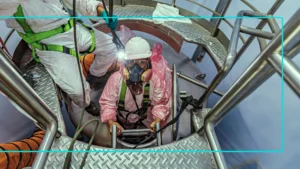
Applying ventilation and monitoring together in real operations
In practice, safe confined space management is not about choosing between ventilation and monitoring—it’s about combining both.
Ventilation systems continue to play a key role in controlling the environment, but monitoring ensures that these systems are actually achieving their purpose. Together, they create a safer and more reliable approach.
Portable gas detectors like the G450 allow workers to carry real-time awareness with them as they enter confined spaces, while fixed or connected monitoring systems provide continuous oversight for longer or more complex operations.
At Inteccon, this combined approach is central to how industries can move beyond basic compliance and toward true operational safety. By integrating gas detection and environmental monitoring solutions, companies gain the ability to not only meet regulations, but to actively prevent incidents.
Moving beyond compliance to real protection
Regulations like OSHA confined space standards exist for a reason, but compliance alone does not guarantee safety. The environments themselves are too dynamic, and the risks too variable, to rely solely on procedures.
Real protection comes from understanding conditions in real time and having the tools to act on that information. It comes from reducing uncertainty and replacing it with data.
Conclusion: you can’t protect what you don’t measure
Confined spaces will always be part of industrial operations. What is changing is how we approach the risks within them.
Ventilation remains essential, but it is no longer enough on its own. Without monitoring, there is no way to confirm that conditions are safe, and without that confirmation, safety becomes an assumption. And in confined spaces, assumptions are where the biggest risks begin.